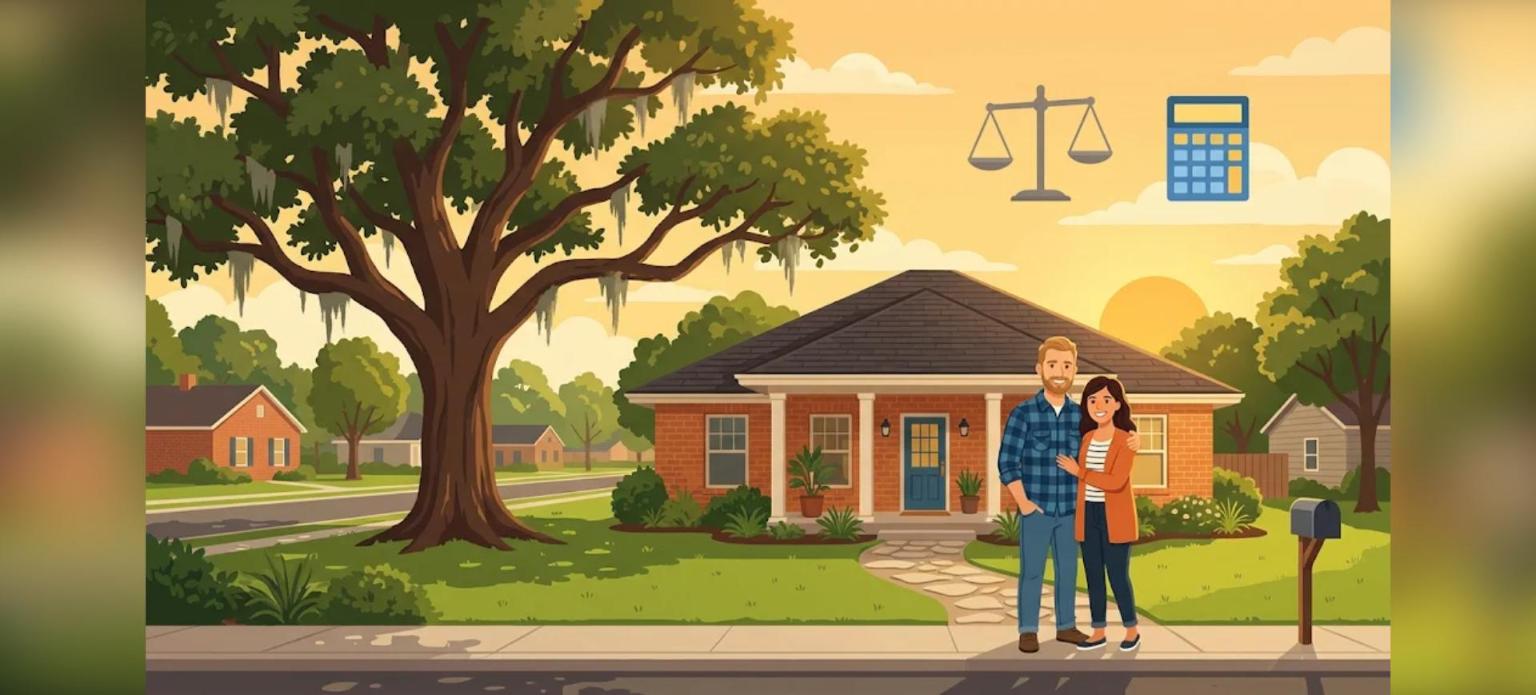


If you are shopping for your first home and hoping to buy with zero down, your Baton Rouge USDA DTI is one of the first numbers a lender will look at. DTI stands for debt-to-income ratio, and it compares your monthly debt payments to your gross monthly income. It quietly decides how much house you can afford, and it trips up more first-time buyers than credit scores do.
Around Baton Rouge, buyers often ask the same thing in local forums and Facebook groups: “My credit is fine, so why did my USDA preapproval come back lower than I expected?” The answer is almost always DTI. This guide breaks down the ratios, what counts as debt, and the simple moves that can help you qualify.
What Is a Baton Rouge USDA DTI?
USDA guaranteed home loans use two ratios. Together they make up your Baton Rouge USDA DTI picture:
- Housing ratio (sometimes called the front-end ratio): your proposed house payment divided by your gross monthly income. That payment includes principal, interest, property taxes, homeowners insurance, flood insurance if required, the USDA annual fee, and any HOA dues.
- Total debt ratio (the back-end ratio): that same house payment plus every other monthly debt on your credit report, divided by your gross monthly income.
USDA’s standard benchmarks are 29% for the housing ratio and 41% for the total debt ratio. You can read the official ratio analysis rules in the USDA Rural Development HB-1-3555 Chapter 11 guidance.
How the 29/41 Rule Works in Real Life
Here is a simple example. Say your household earns $5,000 a month before taxes.
- 29% of $5,000 is $1,450. That is the target ceiling for your full house payment.
- 41% of $5,000 is $2,050. That is the target ceiling for the house payment plus car notes, student loans, and credit card minimums.
If you already pay $450 a month for a car and $150 in card minimums, that leaves about $1,450 for housing. In that case your Baton Rouge USDA DTI lines up on both ratios. Add a second car note, and the house payment has to shrink to fit.
This is why two buyers with the same income can get very different preapproval amounts. The buyer with fewer monthly payments simply has more room.
Can Your Baton Rouge USDA DTI Go Above 41%?
Sometimes, yes. Most USDA files run through the Guaranteed Underwriting System, called GUS. When GUS returns an “Accept,” it can approve ratios above 29/41 because it weighs your whole profile, not just one number.
When a file is manually underwritten, ratios above the standard limits generally need strong compensating factors. Examples include:
- A solid credit history with on-time payments
- Cash reserves left in the bank after closing
- A new house payment close to what you pay in rent today
- Steady job history with the same employer or in the same line of work
- Potential for increased earnings, such as a documented raise
There is no promise a higher ratio will be approved. But a Baton Rouge USDA DTI a bit over 41% is not an automatic no, especially with a clean credit file.
What Counts as Debt (and What Does Not)
Lenders use what shows up on your credit report plus any obligations you disclose. Common items that count toward your Baton Rouge USDA DTI include:
- Auto loans and leases
- Minimum payments on credit cards
- Student loans, including deferred loans
- Personal loans and buy now, pay later accounts that report to credit
- Child support or alimony you pay
- Co-signed loans, unless you can document someone else has been making the payments
Items that usually do not count: utilities, phone bills, car insurance, groceries, and streaming subscriptions. Those matter for your budget, but they are not part of the ratio.
Student Loans and Your Baton Rouge USDA DTI
Student loans surprise a lot of Baton Rouge buyers. If your loans are deferred or show a $0 payment on an income-driven plan, the lender cannot simply ignore them. USDA guidelines generally require the lender to use a calculated payment, often 0.5% of the outstanding balance, when no qualifying payment is reported.
On a $40,000 balance, that is $200 a month added to your Baton Rouge USDA DTI, even if you are not paying anything today. If your documented payment is above zero, the lender can typically use that figure instead. Ask your loan advisor to run it both ways before you start house hunting.
Income Matters Too: The Other Half of the Ratio
DTI is a fraction, so raising the bottom number helps just as much as lowering the top. Lenders look at stable, documented income, typically with a two-year history. Overtime, bonus, and part-time income can count when they are consistent.
Keep in mind that USDA also has household income limits for eligibility. Your qualifying income for DTI and your total household income for eligibility are calculated differently. Our guide to Baton Rouge USDA home loans income limits walks through that side of the equation.
Local Costs That Push Your Ratio Up
In the Baton Rouge area, a few local factors can raise your house payment and tighten your Baton Rouge USDA DTI:
- Flood insurance: homes in parts of East Baton Rouge, Livingston, and Ascension parishes may require it. Get a quote before you make an offer.
- Homeowners insurance: Louisiana premiums have climbed, so use a real quote, not an online estimate.
- Property taxes: these vary by parish and by whether you qualify for the homestead exemption.
- HOA dues: newer subdivisions in places like Denham Springs, Zachary, and Prairieville often have them.
A $100 jump in monthly insurance can reduce your buying power by thousands of dollars. Running real numbers early keeps your search focused on homes that actually fit.
Simple Ways to Improve Your Baton Rouge USDA DTI
If your numbers are tight, these steps can help before you apply:
- Pay down or pay off a credit card. Lowering a balance can lower the minimum payment.
- Pay off a small installment loan with only a few payments left.
- Avoid any new car loan or financed furniture until after closing.
- Ask about adding a co-borrower with steady income.
- Look at homes with lower taxes, insurance, or no HOA.
Small changes add up. Dropping one $300 payment can open up a meaningfully higher price range.
Get Your Baton Rouge USDA DTI Checked Today
The best time to know your Baton Rouge USDA DTI is before you fall in love with a house. A quick prequalification shows your ratios, flags any student loan or insurance surprises, and gives you a real price range to shop with. If USDA is not the best fit, we can compare FHA or VA side by side.
Call any time, day or night:
- 24/7 prequalification hotline: 504-399-4141
- 24/7 application hotline: 504-332-0888
Charles, Mortgage Loan Advisor with Max Mortgage, LLC. 20+ years in mortgage and real estate. NAMB Certified FHA Mortgage Professional.